How Many Board Wipes Should You Run in Commander? (And Which Ones to Pick)
 TamyMay 31, 20268 min read
Greetings, planeswalkers and researchers! Tamy here, continuing my documentation of the ever-evolving Multiverse — and today I'm tackling a question I receive more than almost any other: how many boardwipes should a Commander deck actually run?
After observing dozens of games across tables ranging from casual kitchen-table affairs to high-powered pods, I've developed a framework I'm eager to share. Too few mass removal spells and you watch helplessly as an opponent assembles an unstoppable board. Too many and your hand clogs with sweepers while your own plans stall. The answer, as with most things, lies in understanding your strategy.
The Case for Mass Removal
In a format where four players simultaneously advance their game plans, board states escalate quickly. A single threat is handled with targeted removal, but the fourth player topdecking another creature in an already-full game requires a different tool entirely. Boardwipes are the reset button of Commander — used well, they buy time, neutralize runaway opponents, and keep games from being decided by whoever goldfished hardest in the first four turns.
The question isn't whether to run them. It's how many, and which ones.
How Many Boardwipes Should You Run?
My field research suggests the number varies significantly by archetype. Here's how I'd frame it:
Creature-heavy and aggro decks (1–2 boardwipes): If your deck wins by attacking — tokens, go-wide strategies, +1/+1 counter stompy — you rarely want to wipe the slate clean. Doing so sets you back as much as your opponents. Prioritize 1–2 asymmetrical options that leave your pieces intact, and fill remaining removal slots with targeted answers.
Midrange and "good stuff" decks (2–3 boardwipes): The workhorse category of Commander benefits from having a sweep available at the right moment. Two to three well-chosen boardwipes give you outs when the board runs away from you without cluttering your hand in the early turns.
Control and combo decks (3–5 boardwipes): Decks that win through non-combat means can afford to slam the table repeatedly. Since you're not invested in maintaining board presence, sweepers cost you less than they cost your opponents. Some control builds run five or more, treating mass removal as core interaction.
Enchantress and aura-based decks: Look for boardwipes that spare enchanted creatures. Winds of Rath () destroys every creature that isn't enchanted — in a dedicated enchantress deck, that often means only your opponents' boards are affected.
Reanimator decks: Cards like Living Death () serve double duty — they clear the board and reanimate your graveyard simultaneously. Sequence carefully: fill your graveyard first, then pull the trigger.
Three Qualities That Make a Boardwipe Great
After cataloguing these effects across every color, I've found that the strongest boardwipes share at least one of three properties:
- Cheap to cast: A sweep you can reliably cast by turn four is worth more than an expensive one you sit on until turn eight hoping to survive.
- Modal or flexible: Spells offering choices — or doubling as single-target removal — are rarely dead draws.
- Asymmetrical: Boardwipes that hurt opponents more than you are the gold standard. Getting to reset the table while keeping your own permanents is a tremendous advantage.
The strongest options check more than one box. Let's go color by color.
White: The Archive of Mass Reckoning
White has more boardwipes than any other color, and it's been the cornerstone of mass removal since Magic's earliest days.
Wrath of God

Card spotlight
Four mana. Destroy all creatures. They can't be regenerated. The standard against which every other boardwipe is measured. Wrath of God () has defined white's identity since Limited Edition Alpha, and it remains one of the most reliable, budget-accessible sweepers in the format. Any white deck without a specific reason to avoid it should consider this an automatic inclusion.
Beyond the classic, white offers a deep catalog. Supreme Verdict () is the first choice in blue-white shells — same four-mana cost as Wrath of God, but it cannot be countered, which matters significantly when you're up against open blue mana.
For decks that need exile over destruction, Sunfall () is excellent — it exiles all creatures and leaves an Incubator token that scales with how many it removed, so a massive board sweep also provides a significant threat for your next turn.
Farewell () lets you choose any combination of exiling creatures, artifacts, enchantments, or graveyards. The ability to mix modes makes it almost never a dead draw — some games call for only artifacts and graveyards, others call for the full reset.
A note from my scrolls: Farewell is on the Commander Game Changers list, placing it in Bracket 3 and above. Worth knowing before you sleeve it up for a casual table.
Vanquish the Horde () looks expensive on paper but reduces its cost by for each creature on the battlefield — in most midgame situations, it costs two white mana or less. Final Showdown's Spree mechanic lets it strip indestructibility before destroying — one of the few reliable ways to handle indestructible creatures in white. And Austere Command () remains a format classic — choose two of: destroy small creatures, large creatures, all artifacts, or all enchantments.
Blue: The Art of the Reset
Blue doesn't do "destroy all creatures" cleanly. Instead, it bounces, phases, and inconveniences — which in a four-player game is often just as effective, and sometimes more so.
Cyclonic Rift

Card spotlight
The most commonly played boardwipe in the format — and it isn't close. Cast for its overload cost of at instant speed, Cyclonic Rift returns all nonland permanents your opponents control to their owners' hands. Yours stay put. That asymmetry is devastating: right before your turn, you clear three boards simultaneously and untap into an open table. The bounce effect is worth understanding carefully — permanents return to hand rather than the graveyard, so it doesn't trigger death effects or fill graveyards. Against reanimator strategies, that's almost always correct.
A note from my scrolls: Cyclonic Rift is on the Commander Game Changers list. It's well-suited to Bracket 3 games and above — at lower-power tables, it can generate significant friction at the table.
Evacuation () is the symmetrical budget alternative — all creatures return to hand at instant speed, yours included. Flood of Tears () hits all nonland permanents and rewards you for bouncing four or more of your own permanents — you can immediately put your best permanent back onto the battlefield for free.
Black: Precision Annihilation
Black's boardwipes tend toward efficiency and interaction with life totals or graveyards in ways other colors can't replicate.
Toxic Deluge

Card spotlight
The most efficient creature wipe in Commander. Toxic Deluge () asks you to pay X life as an additional cost, then gives all creatures -X/-X until end of turn. For three mana total, you can sweep most boards; for five or six, you remove even the largest threats. The crucial detail: -X/-X gets around indestructible. Reducing a creature's toughness to zero destroys it regardless of protection effects — something that pure destroy effects cannot accomplish. In 40-life Commander, the life payment is rarely punishing.
Damnation () is black's Wrath of God — destroys all creatures, they can't regenerate. Perfectly symmetrical and perfectly efficient, though its price tag makes it the premium option.
For late-game power, Decree of Pain () destroys all creatures and draws a card for each one — in a full Commander game, that's commonly 10–15 cards of refuel. Its cycling mode also gives all creatures -2/-2 without casting the spell, useful for sweeping small boards mid-combat without committing the full mana cost.
Damn ( / overload ) is one of the format's finest modal cards — spend two mana for single-target removal, or overload for a full creature wipe. It's rarely a dead draw, and in black-white shells it's exceptional.
Red: The Scorched Multiverse
Red's boardwipes deal damage rather than destroying outright — which matters more than it sounds, since damage-based effects interact differently with protection and open up synergies unavailable to traditional destroy effects.
Blasphemous Act

Card spotlight
Blasphemous Act costs on paper and often one red mana at the table — it reduces its cost by for each creature on the battlefield. In most midgame situations, five to ten creatures are present, bringing the cost to between one and four mana for a spell that deals 13 damage to every creature. That's enough to kill virtually anything without built-in damage prevention. Its damage-based nature also creates synergies with red-heavy strategies: cards that trigger from damage taken, or that redirect damage, can turn Blasphemous Act into a one-sided board clear rather than a symmetrical one.
Chain Reaction () deals X damage to each creature where X equals the number of creatures on the battlefield — Blasphemous Act's budget cousin, and nearly as effective in creature-dense games. Starstorm () is instant speed with a cycling outlet — rare for red sweepers, and extremely useful for clearing the board at the end of an opponent's turn before you untap.
Green: The Reluctant Sweeper
I'll be candid: green is not a boardwipe color. It produces mana and grows threats — mass creature removal sits largely outside its philosophical identity. What green does offer are targeted sweepers against specific permanent types, which are often more relevant than a generic creature wipe.
Bane of Progress () is the premier green mass removal effect — a creature that destroys all artifacts and enchantments on entry and grows larger for each permanent destroyed. In artifact-and-enchantment-heavy metas, this routinely clears more than a typical creature wipe would. And for Golgari decks, Culling Ritual () is one of the most impressive entries in my notes — it destroys all nonland permanents with mana value 2 or less and generates a black or green mana for each one destroyed. Against fast mana rocks, dorks, and the many two-drop staples of Commander, it often pays for itself entirely and leaves you with mana to develop your own board.
Beyond Single Colors: The Crossplane Wraths
A handful of multicolor options earn special mention for their sheer asymmetry.
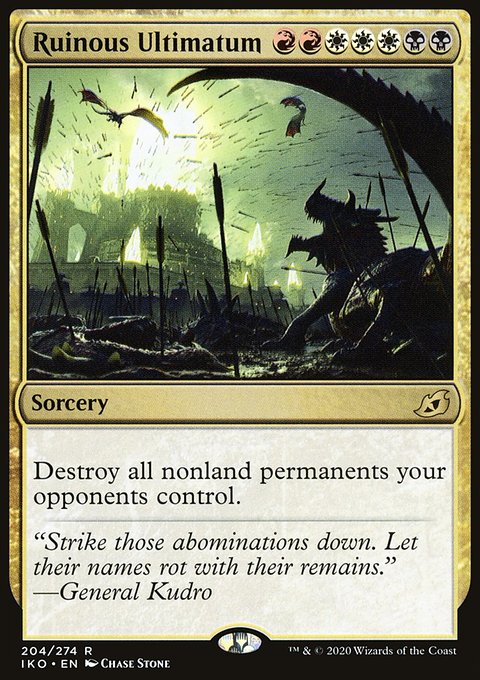
Ruinous Ultimatum
Card spotlight
Ruinous Ultimatum () is as demanding as it looks — seven mana across three colors — and it is one of the most backbreaking cards in Commander when it resolves. It destroys all nonland permanents your opponents control. Yours survive. This isn't a reset; it's a decisive shift in game state disguised as removal. If your mana base can support Mardu colors, I'd argue this is worth building toward. The payoff, when you cast it, is difficult to overstate.
Supreme Verdict bears repeating for blue-white decks: uncounterable, four mana, destroys all creatures. Damn and Culling Ritual round out the multicolor category as format staples for their respective shells.
Frequently Asked Questions
How many boardwipes should a Commander deck run? Most Commander decks benefit from 2–4 boardwipes. Creature-heavy aggro decks can run 1–2; control decks can run 3–5. The sweet spot for midrange is around 3. Quality matters more than quantity — one well-chosen asymmetrical wipe is worth more than three generic ones.
Should I always choose boardwipes that destroy all creatures? Not necessarily. Modal boardwipes like Farewell and Austere Command that hit multiple permanent types often provide more value than a pure creature wipe. Asymmetrical effects that preserve your board are even better.
What's the best budget boardwipe for Commander? Wrath of God and Blasphemous Act are both under $2 and among the most effective sweepers in the format. Chain Reaction and Decree of Pain are under a dollar and punch well above their price.
Do boardwipes work against indestructible creatures? Standard destroy effects don't. For indestructible threats, reach for Toxic Deluge (-X/-X bypasses indestructible), Sunfall or Farewell for exile effects, or Final Showdown which strips abilities before destroying.
Are any boardwipes banned in Commander? Yes — Balance is banned in Commander. Despite functioning as mass removal, its combination of forcing discards down to hand size while also leveling lands and creatures creates game states players find deeply unfun. Avoid it. Everything else discussed in this guide is legal.
Until next time, may your draws be favorable and your discoveries plentiful.
— Tamy, Field Researcher
Enjoyed this post?