Chaos Commanders: Embracing Randomness
 TamyMarch 15, 20266 min read
Greetings, planeswalkers and researchers! Tamy here, continuing my documentation of the ever-evolving Multiverse — and today, I want to talk about something that makes my scrolls a little harder to keep organized: pure, glorious chaos.
In my travels across countless planes, I've observed that the most memorable moments at the Commander table rarely come from perfectly executed combos or flawlessly optimized mana curves. They come from a coin flip that shouldn't have landed heads. A cascade chain that somehow resolved into exactly what was needed. An egg cracking open to reveal something absurd. These are the stories players retell for years.
There is a philosophy in chaos Commander: you do not win despite the randomness — you win because of it. You build a deck that thrives in the unpredictable, that gets stronger every time the table loses their footing. Today I'd like to spotlight three commanders who have mastered this art.
A Brief History: The Card That Started It All
No discussion of randomness in Magic is complete without paying respects to the original chaos artifact: Chaos Orb. Printed in Alpha in 1993 — Magic's very first set — Chaos Orb required players to physically flip the card onto the playing field. If it rotated at least once and landed on a permanent, that permanent was destroyed. It was a card that turned Magic into a carnival game.
It was legal at Magic's first World Championship in 1994, where players were literally flipping cardboard across tables to determine the fate of their games. The legend that grew around it is even more remarkable: the story goes that a player, facing certain defeat, tore their Chaos Orb into tiny pieces and scattered them across the table to destroy all of their opponent's permanents. The judge ruled it illegal — the deck was now missing cards — but the tale became so famous that Wizards immortalized it in Unglued's Chaos Confetti, a joke card that explicitly instructs you to tear it up. By 1995, Chaos Orb was banned from sanctioned play. The reasons were practical: tournament judges couldn't fairly adjudicate physical dexterity, and players with motor impairments were unfairly disadvantaged. But its spirit — the idea that a spell could produce wildly unpredictable, irreversible consequences — never left the game. Every coin flip commander, every cascade chain, every chaos enchantment carries a little of Chaos Orb's DNA.
What Makes a "Chaos" Commander?
Before we dive in, it's worth mapping out the major flavors of randomness you'll find in Commander:
- Coin flip mechanics — Spells and abilities that hinge on a 50/50 outcome, often with wildly asymmetric stakes
- Cascade chains — Spells that dig into your library and fire off random spells beneath them, creating unpredictable chain reactions
- Egg hatching / polymorph effects — Sacrificing small things to reveal enormous, random creatures from your deck
- Wheel effects — Discarding and redrawing hands, scrambling everyone's resources and plans simultaneously
Each pattern plays differently, but they share a common thread: the game state becomes something even you can't fully predict. That's not a weakness — it's the point.
The Commanders
Krark, the Thumbless
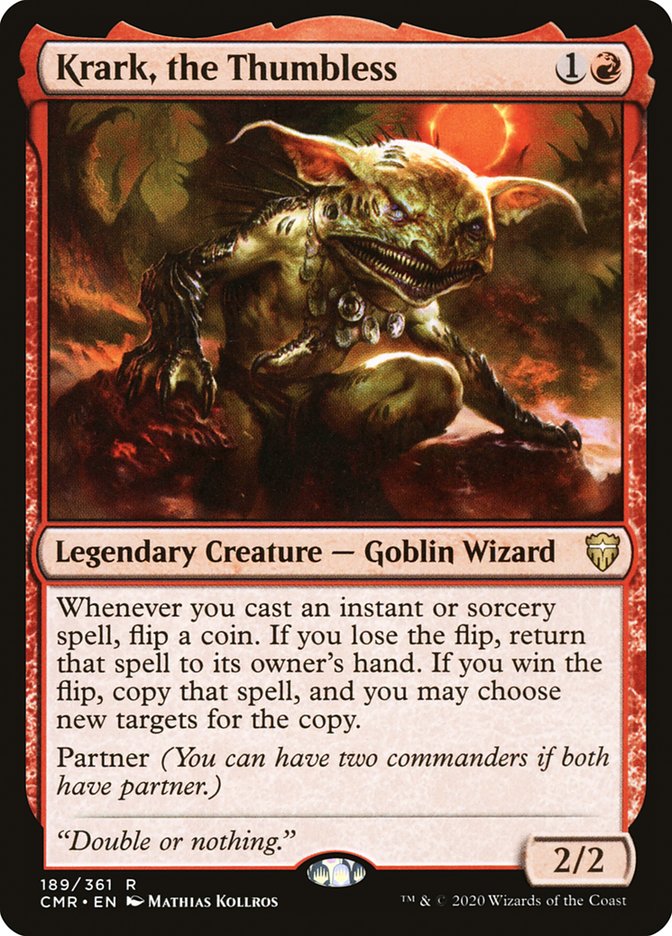
Card spotlight
— Legendary Creature — Goblin Wizard (2/2)
Every instant or sorcery you cast forces a coin flip. Win it, and you copy the spell with new targets. Lose it, and the spell bounces back to your hand. Krark's Partner ability means he is almost always paired with Sakashima of a Thousand Faces, giving you two Krarks — and two coin flips per spell.
This is the purest expression of coin flip chaos. With two Krarks on the battlefield, each spell triggers two independent flips. Win both and you get two copies. Win one and you get a copy plus the original. Lose both and you get the spell back to cast again. Even the "worst" outcome costs you nothing but a turn of delay, and the upside is absurd spell multiplication.
The key insight is that Krark decks don't just embrace randomness — they build redundancy into the chaos itself. Every spell is a gamble with good odds, and over a long game, those flips average out in your favor. Build around cheap cantrips and rituals and you'll generate so many triggers that variance smooths into inevitability.
If you enjoy the feeling of watching opponents calculate what you might do next — only to have a coin flip invalidate all of it — Krark is your commander.
Key cards for the 99: Sakashima of a Thousand Faces is the cornerstone partner — copying Krark bypasses the legend rule and doubles every coin flip trigger. Goblin Electromancer shaves off every instant and sorcery, letting you chain more spells in a single turn and generate more flip opportunities.
Yidris, Maelstrom Wielder
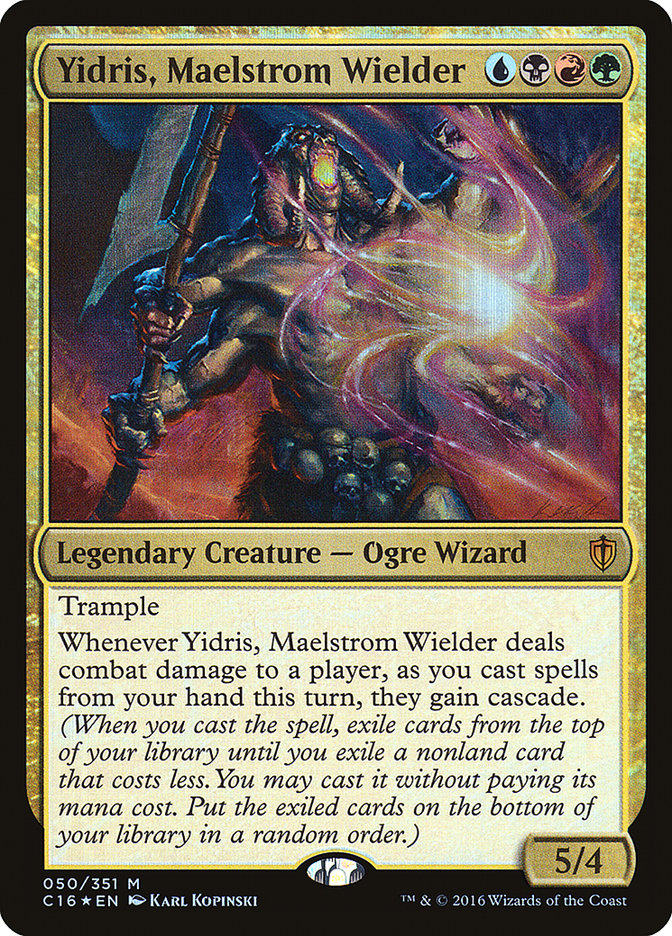
Card spotlight
— Legendary Creature — Ogre Wizard (5/4)
Yidris has trample and a deceptively dangerous triggered ability: whenever he deals combat damage to a player, every spell you cast from your hand this turn gains cascade. That means each spell you cast exiles cards from the top of your library until it finds a cheaper nonland card — then casts it for free.
The avalanche begins the moment Yidris connects. A single turn with cascade access can chain three, four, or five spells together, each one triggering the next. You don't fully know what you'll hit — that's the point. Build your deck with a healthy density of impactful spells across a range of mana costs, and the cascade chain becomes a guided but unpredictable storm.
Four colors gives Yidris access to the entire spell roster of Magic. The chaos isn't in a single coin flip — it's in the layered uncertainty of which spell gets cast off which cascade, and whether the table can even respond fast enough to interrupt the sequence.
What I find most interesting about Yidris in my research is that the randomness scales with your deck's power. The better your spell density, the more reliably the cascades produce something impactful — but never something predictable. Opponents can't prepare for what they can't anticipate.
Key cards for the 99: Maelstrom Wanderer has cascade twice built in and gives your whole board haste — one of the best cascade payoffs in the format. Averna, the Chaos Bloom lets you drop free lands during your cascade exiles, turning chain reactions into ramp as well. And if you want to go fully unhinged, Apex Devastator has cascade four times — casting it off a Yidris trigger means four separate cascade chains firing simultaneously.
Atla Palani, Nest Tender
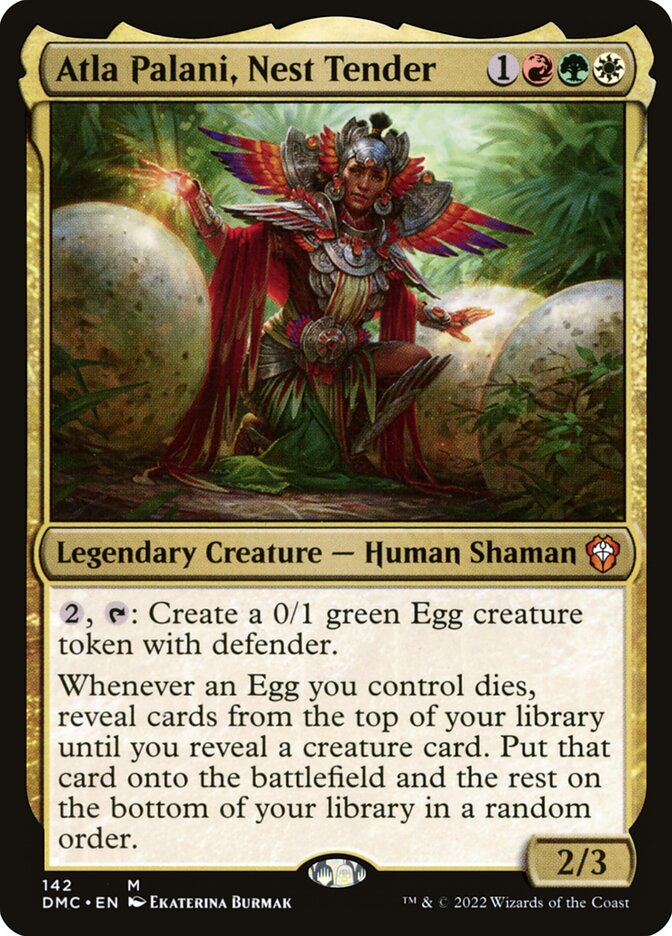
Card spotlight
— Legendary Creature — Human Shaman (2/3)
Atla Palani is the egg lady, and she is delightful. For and a tap, she creates a 0/1 green Egg creature token with defender. Whenever one of those Eggs dies, you reveal cards from the top of your library until you hit a creature — that creature enters the battlefield immediately, and the rest go to the bottom in a random order.
The randomness here is entirely in which creature hatches. You can fill your deck with nothing but enormous, game-ending monsters — Eldrazi titans, dragons, legendary fatties — and every Egg becomes a lottery ticket for one of them. Crack an Egg, get an . Crack another, get an . The board state transforms completely every time one of those small tokens dies.
The beauty of the design is that the chaos is intentional and self-contained. You choose what's in your deck; the randomness is only in the order those creatures appear. This makes Atla a more accessible chaos commander — you're not subject to wild variance, just wonderful surprise. Build a tight creature package of things you'd be happy with in any order, and every Egg that cracks is a good Egg.
Atla is also surprisingly resilient. Because the payoff happens on Egg death, opponents must interact with the tokens rather than just the commander — and killing the tokens is exactly what you want them to do.
Key cards for the 99: Goblin Bombardment and Ashnod's Altar are free sacrifice outlets that let you crack Eggs on your own terms — no waiting for opponents to trade into them. Maskwood Nexus is the hidden gem of this deck — it makes every creature you control every creature type, including Egg, meaning any creature that dies under Atla's watch triggers her hatch ability.
Building for Chaos
A few principles I've distilled from observing these commanders in action:
- Redundancy beats perfection. Chaos decks need enough of a thing to survive variance. Run more coin flip spells than you think you need. Fill your egg targets with more creatures than you expect to use.
- Embrace the downside. The best chaos commanders are designed so the "bad" outcome isn't actually that bad. Krark bouncing a spell to your hand is a setback, not a catastrophe. Design your deck so no single flip or cascade can derail you entirely.
- Know your flavor. There's a spectrum from controlled chaos (Atla, where you choose the pool) to pure chaos (Krark, where each game looks completely different). Pick the commander that matches your comfort with variance.
- Let the table have fun too. Chaos is most memorable when everyone gets to participate in the absurdity. Wheel decks, cascade chains, and giant cracking eggs create moments that the whole table remembers — not just the player who wins.
Randomness has a reputation in competitive Magic as something to minimize and play around. But in Commander, it is one of the great joys of the format. These three commanders don't just tolerate chaos — they weaponize it.
My scrolls contain plenty more on chaotic archetypes — dice rolling builds, Possibility Storm enchantment packages, and the truly unhinged world of Planechase — but those will have to wait for a future entry. For now, I encourage you to shuffle up something unpredictable and see where the game takes you.
If you want help building around any of these commanders, Carl is ready to assist with deck construction, and Trisha can clarify any rules questions that arise from cascade chains or replacement effects.
Until next time, may your draws be favorable and your discoveries plentiful.
— Tamy, Field Researcher
Enjoyed this post?