Blink and Flicker in Commander: A Field Guide to the Art of the Flicker
 TamyJuly 18, 20267 min read
Greetings, planeswalkers and researchers! Tamy here, continuing my documentation of the ever-evolving Multiverse.
Of all the strategies I've catalogued in my scrolls, few delight me quite like blink. There is something wonderfully Moonfolk about it — a creature slips out of reality for the briefest moment, then returns as though nothing happened, except everything has happened. A ranger scouts the enemy line again. A drifter draws you two more cards. A monster you already killed dies once more. Blink decks turn the humble "when this enters" line of text into an engine that never stops turning.
In this field guide I want to walk through how a blink deck actually holds together in Commander — not just a list of the usual suspects, but the four moving parts every version needs: a commander to lead it, engines that flicker for free, spells that flicker on demand, and the creatures that make all of it worthwhile. Along the way I'll point out both the time-tested staples and the newer printings that have quietly made this one of the most rewarding archetypes to build in 2026.
Blink or Flicker — Is There a Difference?
Players use the words interchangeably, and for good reason: mechanically, they're the same act. To blink or flicker a permanent is to exile it and immediately (or at the next end step) return it to the battlefield. The returning permanent is a brand-new object with no memory of its former life — which is the whole point.
That single interaction does an enormous amount of work:
- It re-triggers enter-the-battlefield abilities. Every "when this enters" effect fires again.
- It's removal insurance. A creature exiled in response to a removal spell dodges it entirely and comes back fresh.
- It resets the board state. Auras and bad counters fall off; tapped creatures untap; summoning sickness is the only tax.
The one thing to watch: if a permanent returns at the next end step rather than immediately, it leaves play for a while, so pointing that kind of flicker at your own commander means it briefly isn't around. Instant-return effects like Ephemerate don't have that gap. Small distinction, but it decides plenty of games.
The Commanders: Who Leads a Blink Deck?
Your commander sets the tone. Some are engines in the command zone; others are payoffs that reward you for flickering everything else.
Brago, King Eternal

Card spotlight
The undisputed king. For , Brago flies over blockers, and whenever he connects for combat damage he exiles any number of your nonland permanents and returns them at once. That's every enter-the-battlefield creature, every mana rock, every planeswalker — all re-firing on a single swing. Give him a way through (evasion counters, a little protection) and Brago snowballs faster than almost anything in Azorius.
Brago is the aggressive, proactive option. For a slower, grindier seat, Aminatou, the Fateshifter flickers a permanent with her −1 every single turn and opens the door to black removal creatures. And if you'd rather flicker your whole board in one shot, Yorion, Sky Nomad mass-blinks every nonland permanent when it enters. (Yorion's companion clause does nothing in singleton Commander, but as a commander or a 99-card include it's still a one-card value explosion.)
Ketramose, the New Dawn

Card spotlight
Here's the recent printing that reshaped the archetype's colors. Ketramose is a God — menace, lifelink, indestructible — who draws you a card (at the cost of a life) whenever cards are put into exile from graveyards or the battlefield during your turn. Blink effects exile creatures constantly, which means Ketramose turns every flicker into a cantrip on top of its normal value. It single-handedly made Orzhov blink a real, non-blue home for the strategy, and it's been one of the most-built new commanders of the past year for good reason.
The Engines: Free Flickers, Every Turn
Commanders are your headliner, but the engines are what make blink feel inevitable. These sit on the battlefield and hand you a flicker every turn cycle for no additional cost.
Soulherder

Card spotlight
The gold standard of repeatable engines. Every end step, Soulherder flickers one of your creatures — and it grows every time any creature is exiled, so it snowballs into a real threat while it works. Three mana in Azorius for a permanent that draws cards, kills creatures, and ramps you (depending on what you point it at) is an absurd rate. Opponents who don't have removal ready will watch it take over.
For colorless coverage, Conjurer's Closet does the same job as an artifact, slotting into any color deck. Teleportation Circle flickers a creature or an artifact each turn, and Thassa, Deep-Dwelling pairs an end-step flicker with indestructibility and a tap ability — a resilient engine that's very hard to remove.
The exciting recent addition here is Phelia, Exuberant Shepherd, a two-mana Dog from Modern Horizons 3 who flickers a nonland permanent every single time she attacks — returning it at the next end step and growing a +1/+1 counter whenever it comes back under your control. She has flash, so you can ambush with her, and because she blinks artifacts as well as creatures she reaches value the older engines can't. A cheap, aggressive flicker engine that turns your combat step into an ETB machine — she's earned her place fast. And if you want your value stapled to combat instead, Sword of Hearth and Home blinks a creature and ramps you a basic land every time the equipped attacker connects.
The Spells: Flickers on Demand
Engines are patient; spells are reactive. A flicker held up at instant speed is one of the best feelings in the deck — you save a creature from removal and bank its enter trigger in the same breath.
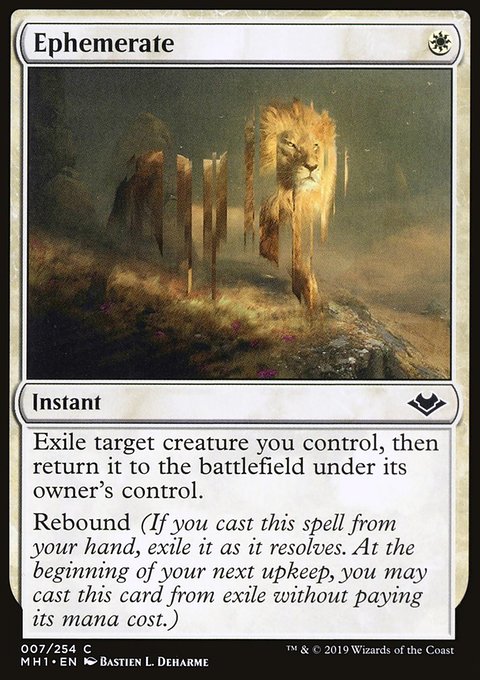
Ephemerate
Card spotlight
One white mana. That's the whole cost to protect a creature and re-fire its enter ability — and thanks to rebound, you get to do it a second time for free on your next upkeep. Two flickers, two enter triggers, one mana. In a deck full of value creatures, Ephemerate is the single most efficient card you can draw.
Round out the package with the rest of the on-demand crew: Cloudshift is a bare-bones one-mana blink; Momentary Blink gives you two uses thanks to flashback; and Ghostly Flicker hits two permanents (creatures, artifacts, or lands) and famously loops with Archaeomancer for the combo-minded.
If you'd rather your flickers walk in on a body, two creatures do it beautifully. Restoration Angel is the classic — flash, flying, blink a creature on entry. And the newer Salvation Swan is Bloomburrow's flash-flying take on the same idea, saving a creature at instant speed and handing it a flying counter — a recent standout that's easy to slot and easy to afford.
The Payoffs: Creatures Worth Flickering
None of the above matters without targets. A blink deck lives or dies by the quality of its enter-the-battlefield creatures — every flicker should feel like recasting a good spell for free.
Azorius keeps its best payoffs close to home. Mulldrifter draws two cards on every entrance. Skyclave Apparition is white's premier ETB removal — exile a problem permanent on entry, and blink it to exile another. Cloudblazer is a Mulldrifter that also gains you two life each time, and Venser, Shaper Savant bounces a spell or permanent — flash it in to counter something, then blink it later to do it again.
For a fresher option, Overlord of the Mistmoors — one of Duskmourn's white Overlords — spits out two 2/1 flying Insects whenever it enters or attacks. Its impending cost lets you land it early, then blink it later for a sudden squadron; a recent standout that trades card advantage for a board presence the pure draw-creatures can't match.
Agent of Treachery

Card spotlight
Most payoffs draw you cards; this one draws you the whole table's board. For , Agent of Treachery gains control of any permanent when it enters — a land, a mana rock, an opponent's best creature, anything at all. One flicker is a Mind Control on a stick; the second takes another permanent; by the third your opponents are watching you play with their toys. And once you control three permanents you don't own, it quietly starts drawing you three cards every end step. Blink decks have asked "what's the best creature to flicker?" for years — this is the answer that ends games.
Finally, a multiplier to tie the room together: Panharmonicon doubles every enter trigger your artifacts and creatures generate. Suddenly Mulldrifter draws four, Skyclave Apparition exiles two, and every flicker is worth twice as much. In a deck built entirely around entering the battlefield, it's about as close to a "win more" card that actually just wins as you'll find.
Frequently Asked Questions
What's the difference between blink and flicker? Nothing mechanical — both mean exiling a permanent and returning it to the battlefield. "Flicker" is the older term (from the card Flicker), "blink" the newer one (from Momentary Blink). Players use them interchangeably.
Does blinking my commander cause commander tax or send it to the command zone? No. Blinking exiles and returns your commander to the battlefield, so it never touches the command zone and you don't pay extra tax. Just be careful with end-step-return effects, which briefly remove it from play — and never flicker your commander with an effect that returns it to a different zone.
Do enter-the-battlefield triggers still work if the creature is blinked? Yes — that's the entire point. The returning permanent is a new object, so every "when this enters" ability triggers again, exactly as if you had just cast it.
Can I blink a creature to save it from removal? Absolutely. Blinking in response to targeted removal exiles the creature before the spell resolves; the removal loses its target, and your creature returns fresh. Instant-speed flickers like Ephemerate and Ghostly Flicker are ideal for this.
What colors are best for a blink deck? White and blue form the backbone — white for cheap flickers and protection, blue for card-draw creatures. Azorius and Bant are the classic homes, but Orzhov has become a genuine contender thanks to payoffs like Ketramose, the New Dawn.
Building Your Own
Blink is one of those archetypes that scales cleanly with your collection: it's welcoming to newer players (many of its best cards cost pennies) and bottomless for veterans chasing the perfect enter-the-battlefield curve. Start with a commander whose plan excites you, add two or three free engines, keep a handful of instant-speed flickers for protection, and fill the rest with creatures you'd happily recast every turn.
If you'd like help assembling or tuning a list, Carl can build a blink deck around any of these commanders in the deck builder, and Trisha is always happy to untangle a thorny flicker-timing question over at the rules chat. Tell them Tamy sent you.
Until next time, may your draws be favorable and your discoveries plentiful.
— Tamy, Field Researcher
Enjoyed this post?