The Best Modal Spells in Commander: Cards That Are Never Dead Draws
 TamySeptember 20, 20265 min read
Most decks lose to the wrong card, not a bad one. You draw the artifact removal against the elf deck, you draw the counterspell three turns after the thing you needed to counter resolved, and you sit there holding a blank. Modal spells are the fix: one slot, several answers, chosen as you cast instead of at deckbuilding time.
The catch is that flexibility is sold, not given. Some modal cards charge a mana, some charge a colour, and plenty charge you a mode you will never once choose. Here are the ones that earn their slot in Commander, grouped by the job they do.
What makes a modal card worth its slot?
Count the modes that are live at your table, not the ones printed on the card. Four options where two matter is a good card. Four where one matters is a worse version of the card that does only that thing, and you paid extra for it.
Card spotlight
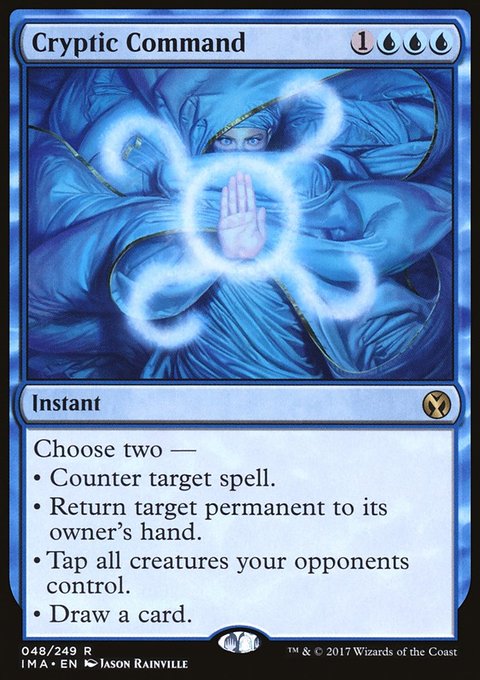
The clearest example of the trade in print. Four modes, choose two, and the bill arrives as — three blue pips in a format full of three-colour decks. Counter-and-draw is the pair you take most nights, which makes Cryptic Command a four-mana counterspell that cantrips. Worth it in mono-blue and two-colour decks with real fixing; a liability in a five-colour pile that can't produce triple blue by turn four.
At the other end is Abrade, reprinted again in Secrets of Strixhaven Commander: three damage to a creature or destroy an artifact, for , at exactly the rate a single-purpose card of either kind would cost. No tax at all. That's the shape to hunt for.
Charms and commands: cheap answers that never rot in hand
The densest concentration of good modal cards in the format. Two to five mana, three or four modes, and the instants among them get held until somebody makes a mistake.

Card spotlight
Choose two of: two damage anywhere, a Treasure, a loot for two, or blow up an artifact. The reason Prismari Command is the best of the cycle is that the Treasure mode is never dead — when the other three modes are all blanks, you are still ramping and fixing at instant speed for . And the two halves can point at different players, which matters more than it sounds at a four-person table.
The rest of the shortlist sorts itself by how often the second mode comes up. Kolaghan's Command is the black-red version, a two-for-one every time. Mystic Confluence and Fiery Confluence let you take the same mode three times, which on the Fiery is six damage to each opponent — though that one's a sorcery, so it's a plan, not an ambush. Boros Charm is the best board-wipe insurance in red-white, at a steep four and a half dollars. Rakdos Charm turns a go-wide board into a burn spell: every creature pings its own controller, so the token player can take lethal off it — and yours ping you. Sultai Charm is fine but wants three specific colours. Skip Simic Charm unless the hexproof mode protects a combo. Three modes that each do a small thing is how a charm ends up as filler.
Lorwyn Eclipsed printed a new Command cycle in January, and Trystan's Command is the one to look at: at you pick two of copy an Elf, return one or two permanent cards from your graveyard to hand, kill a creature or enchantment, or give a player's board +3/+3 and untap it. Expensive, and a sorcery, but every mode is worth a card. Ashling's Command is the same idea in blue-red at instant speed.
Modal removal that answers whatever the table presents
Narrow removal makes you guess three decks in advance. Modal removal defers the guess until you can see what's actually threatening you.

Card spotlight
Two mana, and the third mode is the one nobody reads: destroy target artifact and target enchantment, both, for . Not "choose one or both" with a cost attached — simply a third mode, free. Hull Breach is a sorcery, which is the only real knock on it, and still the most efficient artifact-or-enchantment removal a red-green deck can run at twenty-eight cents.
Then fill in by colour. Valorous Stance kills a big creature or saves yours from a wrath — about as clean a two-mode split as white gets. Dromoka's Command hits two modes for . Casualties of War is the six-mana ceiling: choose one or more of five, pay nothing extra, take a player apart. It's a sorcery and it asks for — four coloured pips, so it's a Golgari card or nothing.
The newest two are both cheap and both good. Giantfall from Lorwyn Eclipsed is bite-or-shatter at if you already have a big creature out, and Glorious Decay gives green a three-mode instant for : artifact removal, four damage to a flier, or graveyard hate that replaces itself. Green has wanted that last mode for years.
Modal board wipes: sweep exactly what you need
A one-size wrath kills your own board as often as it saves you. Modal wipes let you name the problem — which in practice means blowing up the artifact deck's engine while your creatures keep standing.

Card spotlight
Still the best of them, at forty-one cents after the Marvel Super Heroes Commander reprint. Choose two of: destroy all artifacts, all enchantments, all creatures with mana value 3 or less, all creatures with mana value 4 or greater. Build a deck of cheap creatures, split the board along that mana value line, and it's the most one-sided wrath in the format. Six mana, though — Austere Command is a plan, not a panic button.
Cleansing Nova is the five-mana version and picks one of the two big buckets. Merciless Eviction exiles instead of destroying, the one you want against recursion. Brotherhood's End is three mana for either tokens or the mana-rock pile. Perplexing Test bounces rather than kills, and its token mode simply deletes a go-wide board. Farewell is the nuclear option: choose one or more, all exiled, no cost for extra modes.
Worth flagging: Farewell sits on the Game Changers list, so it belongs at Bracket 3 and up rather than in a casual precon upgrade.
The new one is Final Act from Secrets of Strixhaven Commander — , choose one or more of five, including exile all graveyards. Black has never had a wrath that answers a graveyard deck in the same card.
Frequently Asked Questions
What is a modal spell in Magic: The Gathering?
A modal spell says "choose one" (or two, or one or more) and lists several effects; you pick which happens as you cast it. Abrade is the simplest example: damage a creature, or destroy an artifact.
When do you choose the mode on a modal spell?
As you cast it, before anyone can respond — and you can't change modes once it's on the stack, so if someone sacrifices your target in response the spell doesn't switch to another mode. Cast it late, with information.
How many modal spells should a Commander deck run?
There's no target number, because modal cards aren't a category you're filling. Swap a narrow card for a modal one whenever the modal version costs nothing in rate — Abrade over Shock.
What's the best budget modal spell in Commander?
Abrade at ten cents, with Valorous Stance, Glorious Decay and Hull Breach all under thirty cents. Modal cards are cheap as a class: the flexibility that makes them good in Commander doesn't move Constructed prices.
Which modal spells should you start with?
Start with the ones that cost nothing for the choice. Abrade and Hull Breach are straight upgrades on the cards they replace, for pocket change. Then take one modal wipe — Austere Command if your curve splits cleanly, Final Showdown if you want it at instant speed. The MDFCs come last — expensive, and they earn least in a deck that isn't already tight on slots.
To find which narrow cards in your list have a modal replacement, Carl will walk the decklist with you in the deck builder. And when a mode gets weird — your only legal target disappears, or you want to know whether you can pick the same mode twice — Trisha handles that in chat. I asked her about the Agadeem's Awakening mana-value clause before I wrote it down here.
Enjoyed this post?