commander
The Best Stax Pieces in Commander: Slowing the Game on Your Terms
 TamySeptember 13, 20267 min read
The first time I landed Rule of Law in a four-player game I felt clever for exactly one turn. Then I remembered my own deck wanted to cast three spells a turn, and the card was hurting me more than anyone.
That is the whole problem with stax. Most pieces are symmetrical — they tax, cap or lock every player at the table, you included — so a stax card is only good in a deck built to ignore the thing it restricts. Pick the piece that matches your deck's blind spot, not the one with the scariest reputation. Here are the ones that earn a slot, grouped by what they shut down.
What makes a stax piece worth playing?
Two things: it's cheap enough to land before the table develops, and it's asymmetric — either on the card ("your opponents can't…") or through your deck, like a creature deck running a tax on noncreature spells. A piece that slows you as much as everyone else is a bad trade in multiplayer, because three opponents are all getting the same relief from it that you are.
Card spotlight
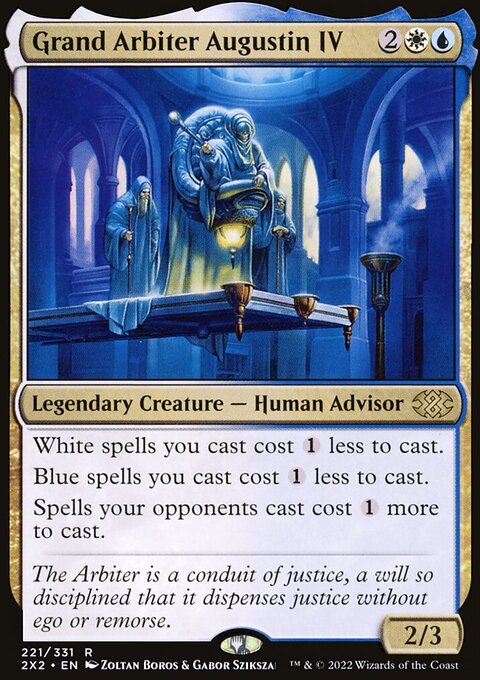
The cleanest asymmetry printed. Your opponents' spells cost more, while your white spells and your blue spells each cost less — so a white-and-blue spell with generic mana in its cost comes down by up to . Grand Arbiter Augustin IV doesn't slow the game; he slows theirs and speeds up yours. Expect him to eat the first removal spell anyone draws.
He's also on the Game Changers list, so he belongs at Bracket 3 tables and up.
The best tax effects: making spells cost more
Taxes are the gentlest stax there is. Nobody is locked out; everything just costs a little more, which hits hardest on the cheap interaction and ramp that decks lean on early.
Card spotlight
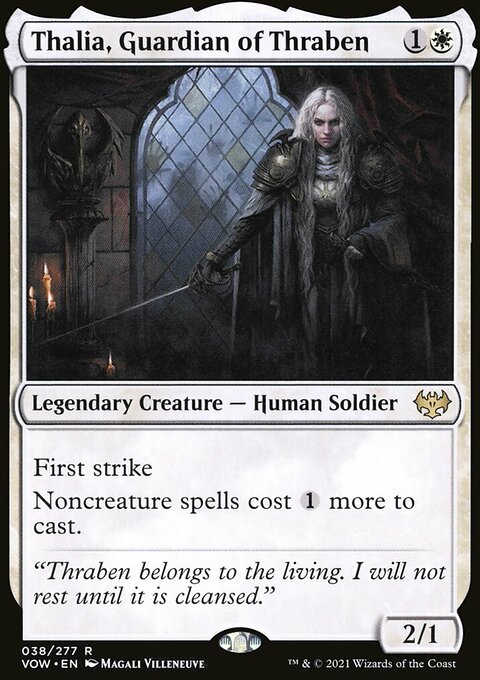
Two mana, first strike, and noncreature spells cost more — for everyone, you included. That last clause is the entire design question. In a creature deck Thalia is close to a one-sided tax; in a deck full of rocks and removal she taxes you just as hard. Forty-five cents, and the first stax piece I hand to anyone building a white creature deck.
Thorn of Amethyst is the same tax on a colourless artifact, and Vryn Wingmare puts it on a flier. Skip Sphere of Resistance unless your deck barely casts spells — it taxes creatures too, which is usually you.
The recent one is Arachne, Psionic Weaver from Marvel's Spider-Man: look at an opponent's hand, then pick a card type other than creature, and spells of that type cost more. It hits everyone, so name the type you run least of. Narrower than Thalia, Guardian of Thraben, but it gets to read a hand before choosing.
Stax pieces that limit how many spells a player can cast
Rule of Law effects stop the turn where someone chains six spells into a win. Against storm and big spellslinger turns they're the best card in your deck. Against a table of creature decks they barely register.

Card spotlight
Three mana, flying, each player can't cast more than one spell each turn — and nonbasic lands your opponents control enter tapped. That second line is why Archon of Emeria is my pick over the enchantments: it slows their fixing on top of their spell count. Being a creature cuts both ways. It attacks, but it also dies to every wrath.
Rule of Law and Eidolon of Rhetoric carry the core effect without the land clause. Deafening Silence only limits noncreature spells, which makes it the right one for a creature deck at . Ethersworn Canonist exempts artifact spells, so it belongs in artifact decks and nowhere else.
The new take on the idea is Jennifer Walters from Marvel Super Heroes: your opponents can't cast spells during your turn. A timing lock rather than a count — no counterspells, no instant-speed removal, no flashed-in blockers while you take your turn — for two mana. Her transform cost makes her green-white for colour identity, not mono-white.
Enter-tapped effects: slowing blockers, rocks and lands
The softest stax at a table, and the one people complain about least. Nothing is stopped — the mana rock just doesn't tap for mana the turn it lands, and the hasty attacker arrives a turn late. Every turn, a little behind.

Card spotlight
A flying two-drop from Marvel's Spider-Man: artifacts and creatures your opponents control enter tapped. That's the enter-tapped half of Blind Obedience on a body that attacks, for 82 cents. Watch the hybrid cost: counts as both colours for colour identity, so Spider-Woman is an Azorius card in Commander.
Authority of the Consuls only hits creatures but costs and gains you a life whenever one of theirs enters. My favourite of the group is Thalia, Heretic Cathar, because her opponents' nonbasic lands enter tapped as well as their creatures.
In red, Zhao, the Moon Slayer from Avatar: The Last Airbender makes every nonbasic land enter tapped, yours included. Pay for a conqueror counter and nonbasic lands become Mountains while it stays on him — at which point he's doing Blood Moon's job, and I'd treat him like it when your table talks brackets.
Hate pieces that shut down one strategy
These don't slow everything. Each one turns off a single plan, which makes them one-sided in practice: you pick the piece that hits their deck and not yours. They're the stax I'd run in almost any deck at a stronger table.

Card spotlight
Your opponents can't cast spells from anywhere other than their hands. In Commander that sentence includes the command zone, so for two mana Drannith Magistrate stops three commanders from being cast — along with flashback, cascade, foretell and every "exile the top card, you may cast it" effect. At a commander-dependent table, nothing else at this cost does as much.
It's a Game Changer, which tells you how Wizards feels about that sentence.
For artifacts, Collector Ouphe and Null Rod stop activated abilities of artifacts — mana abilities included, so Sol Ring stops making mana, yours as well. For creatures, Linvala, Keeper of Silence only shuts off activated abilities of creatures your opponents control, which is why I take her over the symmetrical Cursed Totem whenever I'm in white. Torpor Orb stops creatures entering from triggering anything, Rest in Peace exiles graveyards and keeps them empty, and Aven Mindcensor flashes in to shrink an opponent's search to the top four cards.
The recent card worth knowing is Avatar's Wrath. It airbends every creature but one — exiles them, and their owners may cast them back for — then stops your opponents casting spells from anywhere but their hands until your next turn. You can rebuy yours for each right away. Theirs sit in exile for a full round, because the restriction only lifts at the start of your next turn and most creatures can only be cast on their owner's own turn.
Attack taxes: stax pieces that keep creatures off you
These don't stop combat. They make you the most expensive player to attack, so the damage goes somewhere else. That makes them best in decks that don't plan to win through combat themselves.

Card spotlight
Creatures can't attack you unless their controller pays for each one. Ghostly Prison turns a ten-token swing into a choice between attacking you with a few or attacking someone else with everything, and they choose someone else nearly every time. Three mana, and reprinted often enough to stay affordable.
Propaganda is the blue copy and Windborn Muse the creature one. Norn's Annex covers your planeswalkers too, though its tax can be paid with 2 life per attacker. In enchantress, Sphere of Safety charges per attacker, where X is your enchantment count, and gets out of hand fast.
Two new ones. Nils, Discipline Enforcer puts a +1/+1 counter on up to one creature per player at your end step, and any creature with counters has to pay one mana per counter to attack you or your planeswalkers. The tax climbs every turn. Dáin, Lord of the Iron Hills from The Hobbit is a -per-attacker tax on a two-drop once you control three artifacts, legendaries or Sagas — and Dáin counts himself. Weaker than Ghostly Prison, but nine cents in a legends deck.
Hard locks: Winter Orb, Stasis and mass land denial
This is where stax stops slowing the game and starts ending it. These pieces are built to keep lands tapped or change what they produce, and under the Commander Brackets that's mass land denial — Bracket 4 and up, full stop.

Card spotlight
As long as it's untapped, players can't untap more than one land during their untap steps. Winter Orb is two mana, and it hands the game to whoever built around it with mana rocks and cheap spells. At a table that didn't build for it, it isn't a slowdown. It's a forfeit for three people.
Static Orb caps untaps at two permanents of any kind, Hokori, Dust Drinker stops lands untapping and gives each player one back in their upkeep, and Stasis skips untap steps entirely for a turn. Back to Basics and Blood Moon punish nonbasic mana bases. All correct in the right deck at the right table, and a conversation before the game at any other.
Frequently Asked Questions
What is a stax piece in Commander?
A stax piece is a card — almost always a permanent — that restricts what players can do — cast spells, untap, attack, search or use abilities — so you can develop while the table can't. The name comes from Smokestack.
Is stax allowed in casual Commander brackets?
Most of it, yes. Taxes, spell limits, enter-tapped effects and attack taxes all fit Brackets 1–3, Game Changers aside. Mass land denial like Winter Orb, Stasis and Blood Moon waits for Bracket 4, and Game Changers such as Drannith Magistrate count toward Bracket 3's limit of three.
What's the best budget stax piece?
Thalia, Guardian of Thraben at under a dollar, with Deafening Silence close behind. Both belong in any white deck that leans on creatures.
How many stax pieces should a Commander deck run?
Three to five if stax supports another plan; ten or more only if stax is the plan. Past five, you're usually slowing your own deck as much as anyone's.
How do you beat stax pieces?
Flexible removal. The pieces here split roughly evenly between creatures and artifacts or enchantments, so answers that hit any nonland permanent are worth the most.
Which stax pieces should you start with?
In a casual deck, start with the asymmetric ones: Thalia in a creature deck, Deafening Silence against spellslingers, Ghostly Prison if you don't win through combat. At a stronger table, Drannith Magistrate is the best two mana you can spend. Save the Orbs for decks built around them and tables that agreed to it.
To find out which restriction your own list can actually ignore, Carl will go through it with you in the deck builder and show you where a tax lands on you. And if you're unsure how a piece interacts with commanders, flashback or cost reductions, Trisha handles that in chat — I checked the Avatar's Wrath line with her before writing it down.
Enjoyed this post?